


Introduction: The Heart of the Weld
In high-frequency (HF) longitudinal welded pipe manufacturing, the welding process is the heart of the entire operation.
The quality, strength, and appearance of the final product are all determined at this critical stage.
While the goal is the same—to create a perfect seam—the method used to achieve it makes all the difference.

There are two ways of high-frequency welding: contact welding and induction welding.
Contact Welding
Contact welding uses a pair of copper electrodes in contact with both sides of the steel pipe to be welded. The induced current has good penetration.
The two effects of high-frequency current are maximized due to the direct contact between the copper electrodes and the steel plate.
Therefore, the welding efficiency of contact welding is Higher and has lower power consumption, it is widely used in the production of high-speed and low-precision pipes, and contact welding is generally required when producing particularly thick steel pipes.
However, there are two disadvantages in contact welding: one is that the copper electrode is in contact with the steel plate, and it wears quickly; the other is that due to the influence of the flatness of the steel plate surface and the straightness of the edge, the current stability of the contact welding is poor, and the internal and external burrs of the weld are relatively high. , It is generally not used when welding high-precision and thin-walled pipes.
Induction Welding
Induction welding is wrapping one or more turns of induction coils on the outside of the steel pipe to be welded.
The effect of multi-turns is better than single turns, but it is more difficult to manufacture and install multi-turn induction coils.
The efficiency is higher when the distance between the induction coil and the steel pipe surface is small, but it is easy to cause discharge between the induction coil and the pipe.
Generally, it is advisable to keep a gap of 5-8 mm between the induction coil and the steel pipe surface.
When using induction welding, since the induction coil is not in contact with the steel plate, there is no wear and tear, and the induction current is relatively stable, which ensures the stability of welding.
The surface quality of the steel pipe during welding is good, and the weld seam is smooth.
For precision pipes, induction welding is basically used.
High-frequency straight seam welding pipe making machines require a high degree of cleanliness of the raw material surface.
Welded pipe production line suppliers need to equip themselves with steel strip pretreatment lines, including processes such as leveling, edge trimming, and cleaning, to ensure that the welding interface is free of contamination.
Simultaneously, by adjusting the matching relationship between frequency, power, and welding speed, the weld microstructure can be optimized, reducing defects such as porosity and slag inclusions.
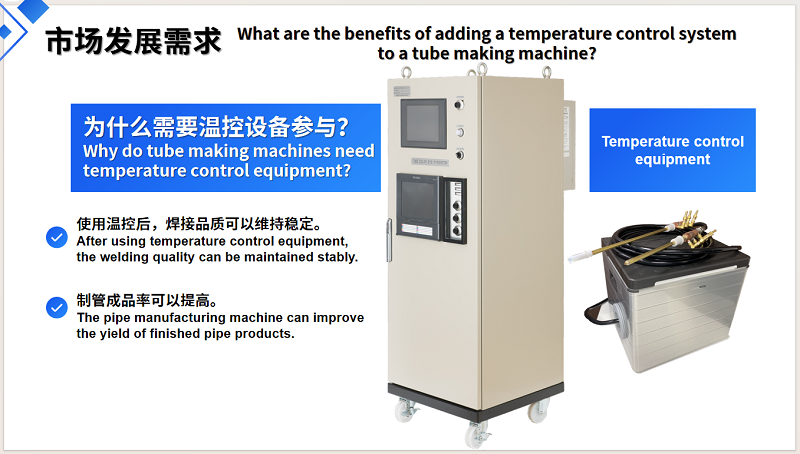
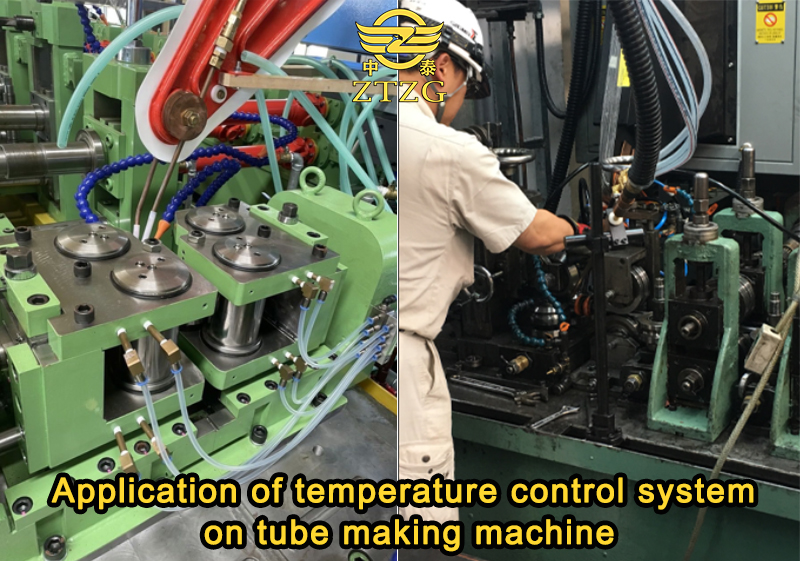
With the increasing demands for steel pipe quality, the welding systems of pipe-making machines have also been upgraded, and many welded pipe production lines are now equipped with welding temperature control systems.
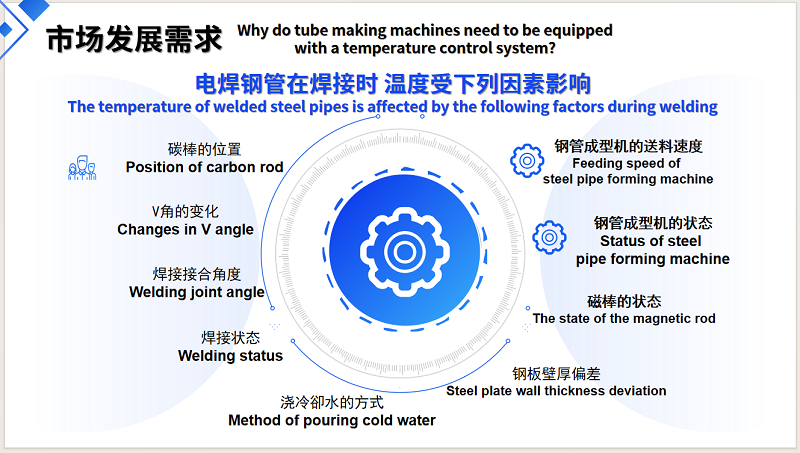
Welding temperature control systems can reduce errors caused by human intervention, improve the quality of finished welded pipes, and result in more perfect welds.
If you have any questions about any stage of the tube-making machine's production process, please feel free to contact us for discussion.
Post time: Apr-23-2023


